Understanding bathroom addition cost before your first conversation with a design team is one of the most useful things a homeowner can do. Adding…
Articles
Types of Bathroom Tiles: 8 Options for Your Next Remodel
Choosing the right types of bathroom tiles is one of the most important decisions in a bathroom remodel, and one of the most overwhelming. The options span materials, formats, finishes, and price points, and the wrong choice affects not just how the bathroom looks but how it performs over time. If you want to explore our approach to designing and tiling custom bathrooms, this guide will give you a strong starting point. In this blog, we cover:
- The eight most widely used bathroom tile types and what distinguishes each one
- Where each tile type performs best in a bathroom application
- Which materials are most durable, lowest maintenance, and most versatile
- How tile format and finish affect the feel of a space
- How tile selection fits into the broader design-build process
Why Tile Type Matters More Than Most Homeowners Expect

Tile is not just a finish decision. It is a performance decision. The substrate you choose determines how well the bathroom holds up to moisture, daily wear, and the specific demands of each zone. A tile that looks great in a showroom but absorbs water or becomes slippery when wet is a problem you will live with for decades.
According to the 2024 Houzz Bathroom Trends Study, porcelain tile is selected by 82% of renovating homeowners for shower wall applications, reflecting how consistently it delivers on both aesthetics and performance in wet environments. Understanding why that number is so high, and where other tile types fit in the picture, is the most useful way to approach the selection process.
We are proud to serve homeowners in Evanston, IL, and nearby communities with full design-build bathroom remodeling, and our architectural designers guide every tile selection as part of a coordinated design rather than an isolated material decision.
8 Types of Bathroom Tiles for Your Next Remodel
Each tile type below has a reason it belongs on this list. Here is what makes each one work, where it performs best, and what to watch for.
1. Porcelain Tile
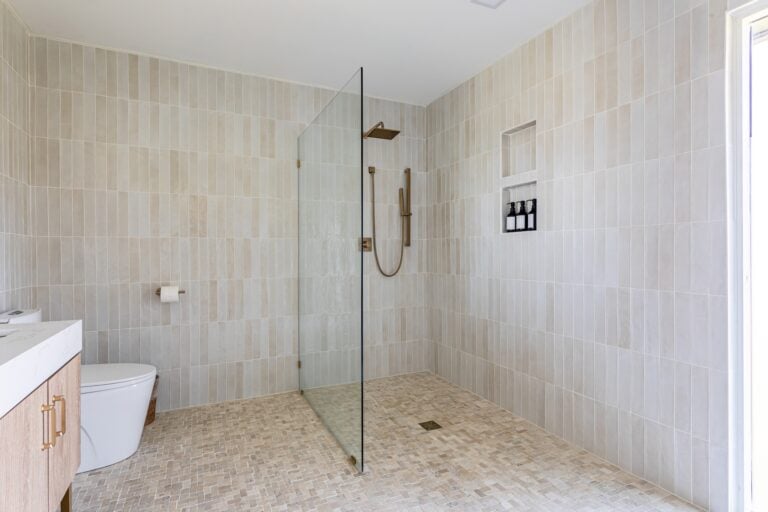
Porcelain is the most widely used bathroom tile for good reason. It is pressed and fired at higher temperatures than other clay-based tiles, which produces an exceptionally dense, low-porosity material that resists moisture, staining, and heavy foot traffic. It holds up in every bathroom zone, from the shower floor to the main floor to the wall, and it is available in a range of sizes, finishes, and surface textures that replicate natural stone, concrete, and wood without the maintenance requirements of those materials.
- Best for: Shower walls, shower floors, bathroom floors, and feature walls across all bathroom styles
- Finish options: Matte, polished, textured, and wood-look or stone-look surfaces in virtually any color or pattern
- Maintenance: Extremely low. Dense composition resists staining and requires only regular cleaning to maintain appearance
2. Ceramic Tile
Ceramic tile is fired at lower temperatures than porcelain, which makes it slightly more porous and less dense but also easier to cut and install. It is the most affordable tile option and performs well in lower-moisture bathroom zones like walls and floors outside the shower. In a shower application, ceramic is best used on walls rather than floors, where the porosity of the material is less of a concern.
- Best for: Bathroom walls, backsplash areas, and floor applications outside the shower enclosure
- Finish options: Glazed surfaces in an enormous range of colors, patterns, and textures, including subway tile profiles
- Maintenance: Low to moderate. Glazed surface resists staining but the underlying material is more absorbent than porcelain if the glaze chips
3. Natural Stone Tile
Natural stone tile, including marble, travertine, slate, and quartzite, brings warmth, texture, and a sense of permanence to a bathroom that manufactured tiles cannot fully replicate. Each piece is unique, which gives a stone-tiled bathroom a character that no two projects share. The tradeoff is maintenance. Natural stone is porous and requires sealing on installation and periodically thereafter to prevent staining and moisture penetration.
- Best for: Feature walls, freestanding tub surrounds, and bathroom floors in design directions that call for natural warmth and character
- Finish options: Honed, polished, brushed, and tumbled finishes each produce a dramatically different look from the same stone
- Maintenance: Higher than ceramic or porcelain. Requires sealing and careful cleaning products that do not etch or damage the stone surface
4. Subway Tile
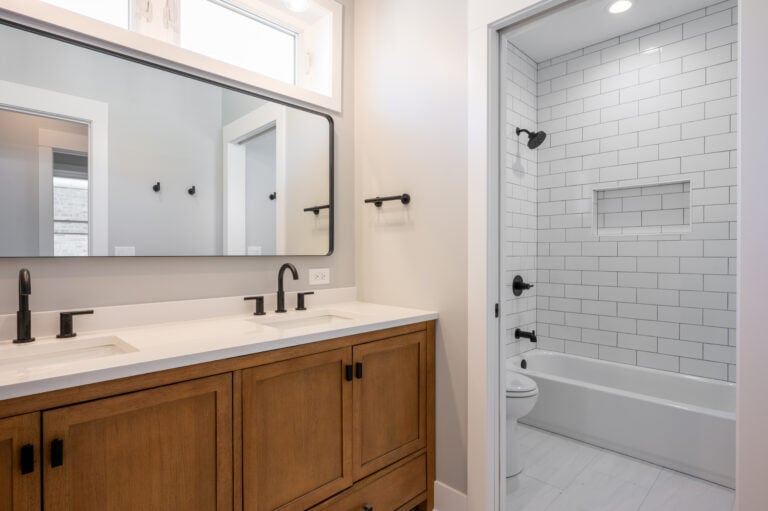
Subway tile is a specific format rather than a material. The classic three-by-six-inch rectangular tile can be produced in ceramic, porcelain, or glass, and it has remained one of the most consistently popular bathroom tile choices for over a century because it works across nearly every design direction. The familiar format reads as clean and timeless in a traditional bathroom and as quietly contemporary in a more modern one.
- Best for: Shower walls, bathroom walls, and backsplash areas in virtually any bathroom style
- Finish options: Glossy, matte, beveled, and handmade-look surfaces in white, off-white, and a growing range of colors and tones
- Maintenance: Low. Standard glazed surface cleans easily, though grout lines require regular attention to maintain appearance
5. Mosaic Tile

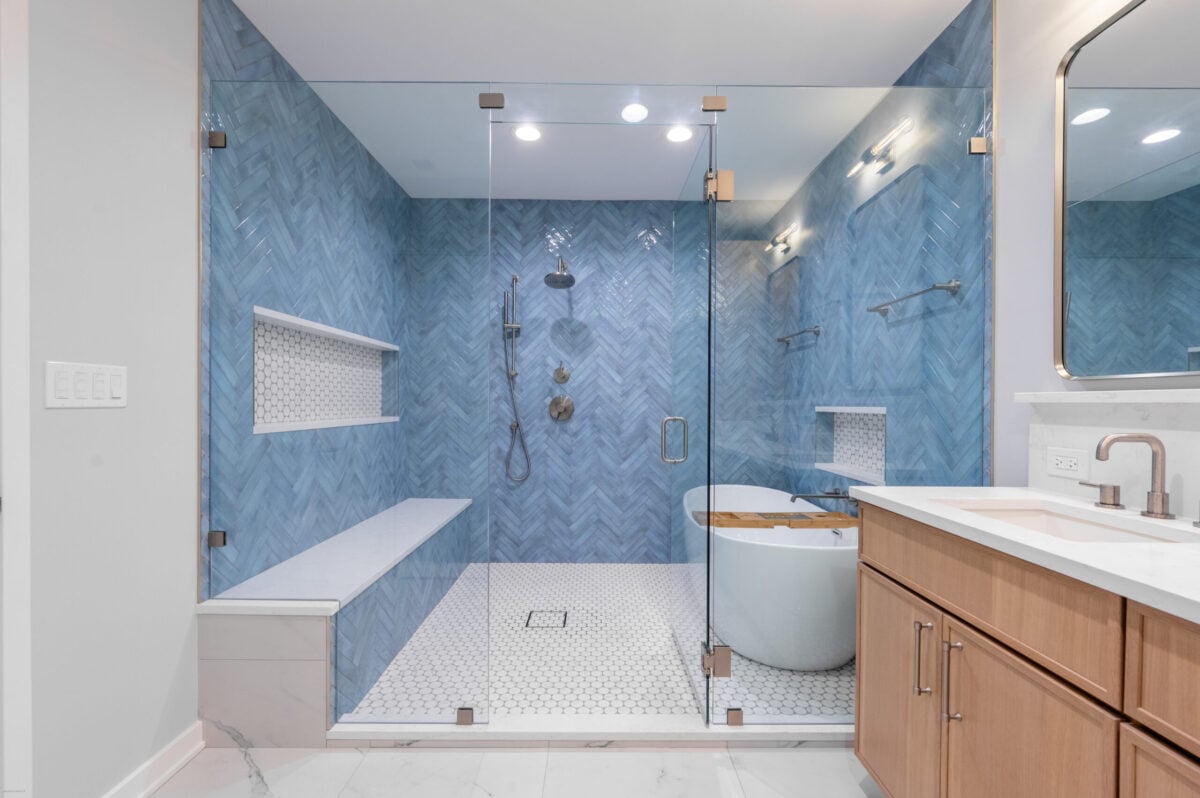
Mosaic tile refers to any tile format where small individual pieces are mounted on a mesh backing for installation. The pieces can be glass, porcelain, ceramic, or stone, and they can be arranged in a uniform grid or in irregular patterns. Mosaic tile is most effective as an accent element, used in a shower niche, on a feature wall, or as a floor inset, rather than across an entire bathroom surface where the volume of grout lines creates a maintenance burden.
- Best for: Shower niches, floor accents, feature walls, and decorative insets within a larger tile application
- Finish options: Glass mosaic for reflective depth, stone mosaic for natural texture, porcelain mosaic for durability with design flexibility
- Maintenance: Moderate to high depending on the material. The large number of grout lines in a mosaic application requires consistent cleaning attention
6. Glass Tile
Glass tile is a specialty material that adds reflective depth and luminosity to a bathroom surface that no other tile type can match. It is most commonly used as an accent on shower walls or as a backsplash material, where the way it interacts with light creates a visual effect that contributes to the overall feel of the space. Glass tile requires a specific installation substrate and adhesive because it is non-porous and does not bond the same way ceramic or porcelain does.
- Best for: Shower wall accents, niche surrounds, and feature wall applications where reflective depth is a design priority
- Finish options: Clear, frosted, iridescent, and back-painted in a wide range of colors
- Maintenance: Low on the tile surface itself, which does not absorb staining. Grout lines require the same attention as any other tile application
7. Large Format Tile
Large format tile is not a material type but a format category, typically referring to tiles with at least one dimension of 15 inches or larger. Large format tiles create fewer grout lines across a wall or floor surface, which makes a bathroom feel cleaner, larger, and more contemporary. They work in porcelain, ceramic, and stone materials and are particularly effective in shower enclosures where minimizing grout lines also reduces the long-term maintenance burden.
- Best for: Shower walls, bathroom floors, and any application where minimizing grout lines and maximizing the visual field of the tile surface is the goal
- Finish options: Available in any material finish. Stone-look and concrete-look large format porcelain are among the most widely used
- Maintenance: Lower than smaller tile formats because fewer grout lines means less surface area requiring regular grout cleaning
8. Encaustic and Cement Tile
Encaustic and cement tiles are unglazed tiles with color and pattern that runs through the full thickness of the tile rather than sitting as a surface glaze. They bring a handmade, artisanal quality to a bathroom floor that no other tile type replicates, and they are experiencing renewed popularity as homeowners look for tile that adds personality and character rather than simply filling a surface. Like natural stone, they require sealing and careful maintenance to perform well in a bathroom environment.
- Best for: Bathroom floors, powder room floors, and feature applications where pattern and personality are the primary design goal
- Finish options: Geometric patterns, floral motifs, and solid colors in a matte, unglazed surface
- Maintenance: Moderate to high. Requires sealing before use and periodic resealing. Not recommended for wet shower floor applications due to porosity
Common Questions About Bathroom Tile Selection

These are the tile questions Evanston homeowners ask most often during the design process.
What tile is best for a shower floor?
The shower floor requires a tile that is slip-resistant, moisture-impervious, and easy to clean. Textured porcelain in a smaller format, such as two-by-two-inch or four-by-four-inch, provides more grout lines that add grip. Large format tiles can work on a shower floor when they have a textured or matte surface with adequate slip resistance. Glass tile and polished stone are not recommended for shower floors.
How do I choose between matte and glossy tile?
Matte tile hides water spots and fingerprints better than glossy and provides more slip resistance on floor applications. Glossy tile reflects more light and reads as brighter and more polished in a space. In a small bathroom, glossy wall tile can help the room feel larger. On a floor, matte or textured surfaces are almost always the more practical choice.
Does grout color matter as much as tile color?
Yes. Grout color dramatically affects how the finished tile installation reads. A contrasting grout color emphasizes the tile pattern and each individual tile. A matching grout color minimizes the grid and makes the surface read as more continuous. Your design team can show you both options in the context of your full tile selection before anything is ordered.
Choose Your Bathroom Tile With 4Ever Remodeling
Tile selection is one of the most personal decisions in a bathroom remodel, and it is most effective when it is made in the context of the full design, including the cabinet finish, countertop material, fixtures, and lighting, rather than in isolation.
At 4Ever Remodeling, our architectural designers guide every tile decision as part of a coordinated design studio selection process. Every choice is reviewed in a full 3D render before materials are ordered, and every completed bathroom is backed by a comprehensive labor warranty.
Ready to start selecting tile for your bathroom? Reach out to our design team to schedule your consultation today.
Written By: 4Ever Remodeling
Recent Articles